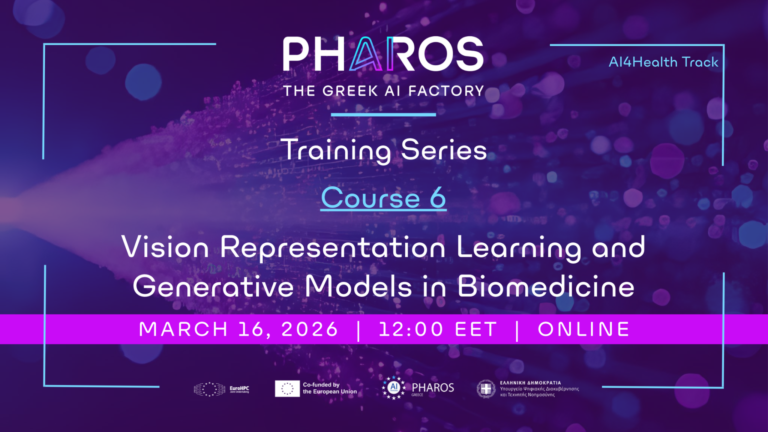
PHAROS AI Factory announced the 6th Course of its Training Series, with the title “Vision Representation Learning and Generative Models in Biomedicine“, under the AI4Health Topic, that successfully took place on March 16th, 2026.
Presentation language: Greek
Audience: This course was intended for data scientists and Machine Learning engineers, biomedical and computational researchers, PhD and MSc students in AI, biomedical engineering or computer vision, as well as professionals in medical technology, digital health and life sciences.
Description: This course explored state-of-the-art machine learning techniques for biomedical image analysis, focusing on how deep neural networks learn visual representations for tasks such as classification, segmentation and anomaly detection. The first part introduced vision representation learning, covering convolutional neural networks, transfer learning and self-supervised approaches, with examples from medical imaging and histopathology. The second part focused on generative models, including Variational Autoencoders (VAEs) and Generative Adversarial Networks (GANs), and their applications in data augmentation, image synthesis and scientific discovery. Through theory, demonstrations and real-world examples, participants gained practical insight into how these techniques are applied in modern biomedical AI workflows.
Learning Objectives
By participating, attendees:
- Gained a deeper understanding of vision representation learning techniques in biomedicine
- Understood the role of generative models in biomedical image analysis
- Learned how modern deep learning architectures are applied to medical and biological data
- Engaged with practical examples and case studies drawn from real-world research
Learning Outcomes:
After completion, participants were able to:
- Explain core principles of representation learning and generative modeling
- Analyze biomedical imaging problems and select appropriate modeling approaches
- Evaluate when and how generative models can be applied in biomedical projects
- Identify next steps for further research or implementation in professional settings
The course’s presentation material can be found here.
The course’s recordings can be found here.