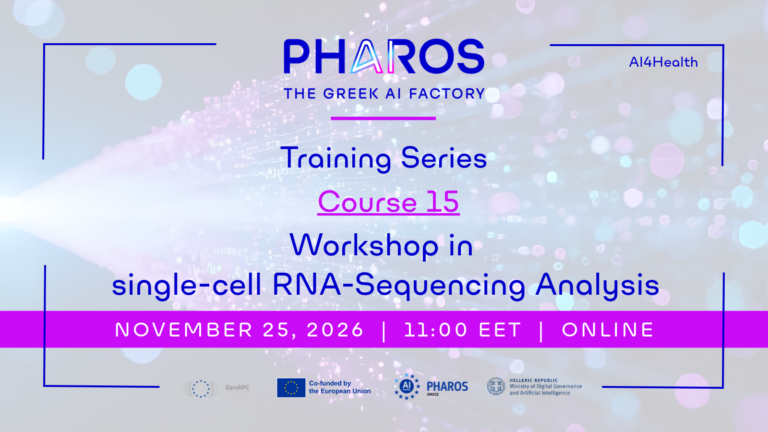
PHAROS AI Factory announces the 15th Course of its Training Series, under the title “Workshop in single-cell RNA-Sequencing Analysis“, under the topic AI4Health, held online via Zoom on November 25th, 2026.
Presentation language: English
Course Description: This workshop provides a comprehensive introduction to single-cell RNA sequencing (scRNA-seq) data analysis using Scanpy, a Python-based toolkit for analyzing single-cell transcriptomics data. Through a combination of theoretical lectures and hands-on exercises, participants will become familiar with the key concepts, computational methods, and analytical steps involved in a standard scRNA-seq analysis workflow. The workshop covers essential stages of single-cell data analysis, including quality control, preprocessing, highly variable gene selection, dimensionality reduction, clustering, differential gene expression analysis, and cell-type annotation. Particular emphasis is placed on understanding the rationale behind analytical choices, the impact of parameter selection, and common challenges and pitfalls in interpreting results. By the end of the workshop, participants will have gained practical experience in processing and exploring scRNA-seq datasets, identifying distinct cellular populations, and annotating cell types using marker genes and enrichment-based approaches. The workshop aims to equip participants with the foundational knowledge and practical skills needed to perform and critically evaluate single-cell transcriptomics analyses.
Audience: Bioinformaticians, Biomedical Data Scientists, Academic Researchers, Master Students, PhD students
Location: Online via Zoom (you will get the zoom link upon registration)
Learning Objectives:
- Gain a deeper understanding of scRNA-seq data structures, formats, complexities (like sparsity), and standard analysis pipelines.
- Understand the mathematical and biological rationale behind essential steps such as quality control metrics, normalization techniques, dimensionality reduction, clustering, and marker gene discovery.
- Apply learned concepts in Python using Scanpy to process, analyze, and interpret single-cell datasets.
- Successfully execute differential gene expression analysis to identify marker genes and annotate distinct cell types within a heterogeneous dataset.
- Interact directly to clarify best practices, parameter tuning, and how to avoid common pitfalls in single-cell bioinformatics.
The course’s agenda can be found here.
Register to attend by filling out the form here.